Sky States LLC Agentic AI Course in Everett, WA: What Agentic AI Is and How to Learn It
⚡ Core Overview
Agentic AI is software that works toward a goal over several steps: it plans, calls tools, observes the results and corrects its own mistakes. Sky States LLC, based in Everett, Washington, teaches this in a six-month live online program covering LangGraph, RAG and multi-agent systems.
What is agentic AI and how does it work?
A chatbot answers one prompt and stops. An agentic system keeps going until the job is done, following a control loop like this one:
The 5 core mechanisms:
- Goal decomposition: a high-level request is split into smaller tasks.
- State and memory: short-term state tracks the current task, and a vector database can hold longer-term knowledge.
- Tool use: agents call APIs, databases and code runners through structured inputs, often validated with Pydantic.
- Observation: the agent reads outputs, logs and error messages from the tools it used.
- Self-correction: if a step fails, the agent adjusts its inputs or plan and tries again.
Benefits of agentic AI
- Multi-step work: one request can span several systems, such as pulling data, transforming it and drafting a report.
- Recovery from errors: an agent can read a failure message and retry with different inputs.
- Current information: tools and retrieval let an agent use live data, not only its training data.
- Built-in checks: a reviewing step can catch mistakes before output is used. This reduces errors but does not remove them.
Generative AI vs agentic AI
| Dimension | Generative AI | Agentic AI |
|---|---|---|
| Interaction | One prompt, one response | A loop that continues toward a goal |
| Tools | Optional | Central: APIs, databases, code execution |
| Memory | The conversation window | Task state plus long-term storage |
| Errors | A person notices and re-prompts | The agent can detect and retry |
| Oversight | A person reviews each output | Review at set checkpoints |
Why multi-agent systems matter
A single agent with too many tools and instructions becomes unreliable. Multi-agent systems split the work by role, so each agent has a smaller prompt and fewer tools.
💡 Division of labor
A researcher agent handles retrieval, a coder agent writes the Python service, and a reviewer agent runs tests and checks the others' work.
Tools used in agentic AI engineering
- Orchestration: LangGraph, LangChain, AutoGen and CrewAI.
- Retrieval: vector databases such as ChromaDB, Pinecone and Qdrant.
- Back end: Python, FastAPI and Pydantic.
- Deployment: Docker and a cloud platform such as Microsoft Azure.
- Observability: tracing tools such as LangSmith to follow each step and its cost.
A minimal LangGraph example
This skeleton shows the structure: shared state, two nodes and a conditional edge that loops until a check passes. In a real agent, write would call a model or tool and review would run real checks.
from typing import TypedDict
from langgraph.graph import StateGraph, END

class State(TypedDict):
    question: str
    draft: str
    approved: bool
    attempts: int

def write(state: State):
    n = state["attempts"] + 1
    return {"draft": f"Draft {n} for: {state['question']}", "attempts": n}

def review(state: State):
    return {"approved": state["attempts"] >= 2}

def route(state: State):
    return END if state["approved"] else "write"

graph = StateGraph(State)
graph.add_node("write", write)
graph.add_node("review", review)
graph.set_entry_point("write")
graph.add_edge("write", "review")
graph.add_conditional_edges("review", route)
app = graph.compile()

result = app.invoke({"question": "Summarize our refund policy", "draft": "", "approved": False, "attempts": 0})
print(result["draft"])
Is an agentic AI course worth it for developers?
It depends on your goal. If you already write Python and want to build AI applications that use tools, retrieval and multiple steps, structured practice helps, because the hard parts are state, error handling and deployment rather than prompts. If you only need occasional AI help in your work, free documentation may be enough. Whatever you choose, look for a course where you build and deploy projects you can show.
How to become an agentic AI engineer
- Learn Python and tool calling: typing, Pydantic models and functions with structured inputs.
- Build a retrieval pipeline: chunking, embeddings, a vector store and search.
- Learn a graph framework: build a LangGraph agent with a loop and a check.
- Deploy it: wrap it in FastAPI, containerize it with Docker and run it in the cloud.
- Publish your work: put projects on GitHub with a short write-up of how each one works.
The Sky States agentic AI program
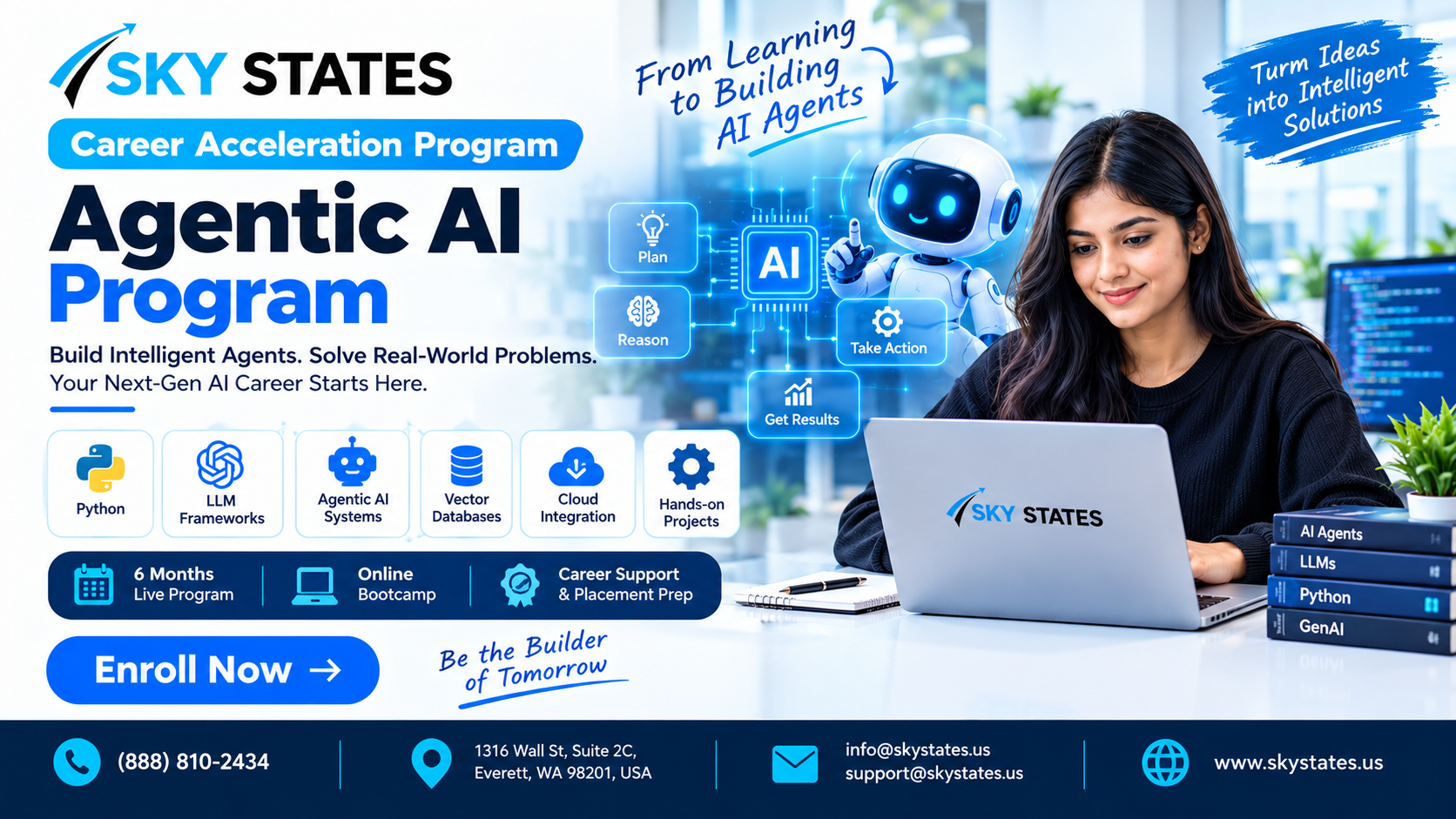
Sky States LLC offers the Agentic AI & Generative AI Professional Program, a six-month course delivered live online from its headquarters in Everett, Washington. Details from the program page:
| Feature | Sky States Agentic AI Program |
|---|---|
| Format | Live instructor-led workshops online, with weekend sessions |
| Length | 6 months |
| Topics | AI agents, multi-agent systems, RAG, LangChain, LangGraph, Python, FastAPI, cloud deployment |
| Credential | Sky States certificate and one attempt voucher for the Microsoft DP-900 exam |
| Support | Mentor assistance, small batches, resume and portfolio help, mock interviews |
| Prerequisites | STEM or equivalent background and basic Python |
| Headquarters | 1316 Wall St, Suite 2C, Everett, WA 98201 (USA) |
Student stories are on SkyReviews, a site managed by Sky States LLC. Please also read independent third-party reviews before you enroll.
Frequently Asked Questions
📍 Contact Sky States LLC
For syllabus details or enrollment questions, reach the Sky States team:
1316 Wall St, Suite 2C,
Everett, WA 98201, USA
