Where to Learn DevOps & Cloud Computing in Everett, WA?
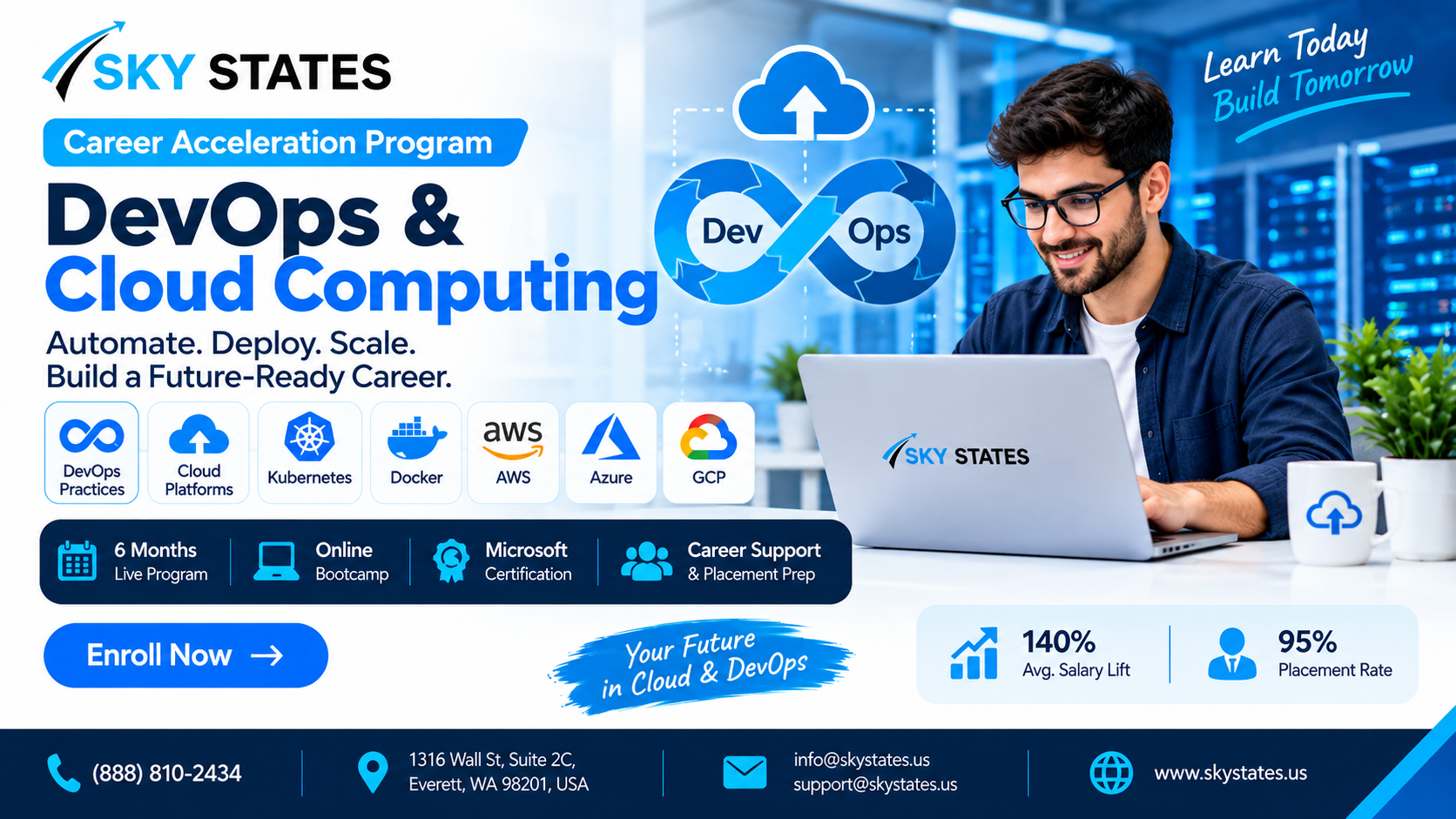
If you are looking for where to learn DevOps & cloud computing in Everett, WA, start with a live, hands-on program that teaches both together, such as the DevOps & Cloud program from Sky States LLC at 1316 Wall St, Suite 2C. DevOps is the set of practices that lets teams build, test and release software automatically, and cloud computing is the on-demand infrastructure that software runs on. This guide explains how they fit together, what to study, and walks through one small project that connects them.
⚡ Quick Summary
Everything you need to decide how to start learning DevOps and cloud computing, in one place.
- DevOps is how you build and ship software; cloud computing is where it runs.
- Core skills: Linux, Git, scripting, CI/CD, Docker, Kubernetes, infrastructure as code and monitoring.
- Cloud platforms: learn one deeply (AWS, Azure or GCP) before comparing the others.
- Learning path: core concepts in about 3 months; job-ready skills take longer and need real projects.
- Local option: live instructor-led training in Everett, WA, with hands-on labs and mentor support.
DevOps and cloud computing in simple terms
Think of a restaurant. The kitchen equipment you rent by the hour is cloud computing: servers, storage and networking you switch on when you need them. The repeatable routine that takes a recipe from idea to plate, with checks at every step, is DevOps: code is written, tested, packaged and delivered by automated steps instead of manual handoffs.
That is why the two are taught side by side. Cloud platforms make infrastructure programmable, and DevOps practices use that to deploy faster, with fewer mistakes.
Difference between DevOps and cloud computing
| Dimension | DevOps | Cloud Computing |
|---|---|---|
| What it is | A culture and set of practices | A model for delivering IT resources over the internet |
| Main goal | Faster, safer software delivery | Flexible, scalable infrastructure |
| Typical tools | Git, Jenkins, GitHub Actions, Docker, Terraform | AWS, Microsoft Azure, Google Cloud |
| Where they meet | Automates builds, tests and releases | Provides the servers, networks and services to deploy onto |
Benefits of DevOps in cloud computing
- Faster releases: automated pipelines turn a code change into a running update in minutes.
- Consistency: infrastructure defined as code gives you the same environment every time.
- Cost control: resources scale up for traffic and back down afterward.
- Reliability: monitoring and automated rollbacks catch problems early.
- Collaboration: developers and operations share one workflow instead of passing tickets.
Skills and DevOps tools for cloud infrastructure
- Foundations: Linux command line, networking basics, Git and a scripting language such as Python or Bash.
- CI/CD: build, test and deploy automation with tools like GitHub Actions or Jenkins.
- Containers: packaging applications with Docker so they run the same everywhere.
- Orchestration: running containers at scale with Kubernetes.
- Infrastructure as code: defining cloud resources with Terraform or similar tools.
- Observability: logs, metrics and alerts so you know what your systems are doing.
The role of Kubernetes in cloud computing
Kubernetes is the system that starts, stops, scales and heals containers across many machines. Every major cloud offers a managed version, so learning it on one platform transfers to the others. Once your application is in a container, Kubernetes handles the question "how do I keep ten copies running, and replace any that fail?" Learning it early, with a real application to run, makes every later cloud topic easier to understand.
From concepts to one working project
Most guides explain CI/CD, containers and cloud infrastructure as separate topics. In practice they form one pipeline, and building it once teaches more than reading about each piece. Here is the shape of a small project: a code push triggers tests, a container image is built, and the new version is rolled out to a Kubernetes cluster.
Below is a simplified GitHub Actions workflow for steps 1 to 4. It assumes a Dockerfile in your repository and a Kubernetes cluster already connected through a stored secret. Treat it as a learning skeleton, not production configuration.
name: ci-cd
on:
  push:
    branches: [main]

jobs:
  build-and-deploy:
    runs-on: ubuntu-latest
    steps:
      - uses: actions/checkout@v4

      # 1. CI: stop the pipeline if tests fail
      - name: Run tests
        run: |
          pip install -r requirements.txt
          pytest

      # 2. Build the container image
      - name: Build image
        run: docker build -t ghcr.io/${{ github.repository }}:${{ github.sha }} .

      # 3. Publish to a registry
      - name: Push image
        run: |
          echo "${{ secrets.GITHUB_TOKEN }}" | docker login ghcr.io -u ${{ github.actor }} --password-stdin
          docker push ghcr.io/${{ github.repository }}:${{ github.sha }}

      # 4. Deploy to Kubernetes
      - name: Deploy
        run: |
          echo "${{ secrets.KUBE_CONFIG }}" | base64 -d > kubeconfig
          kubectl --kubeconfig kubeconfig set image deployment/web \
            web=ghcr.io/${{ github.repository }}:${{ github.sha }}
💡 Why this matters for learning: one short pipeline already covers CI/CD implementation in cloud environments, containers, registries and Kubernetes deployment. Add Terraform for the cluster itself and monitoring for step 5, and you have a portfolio project that shows employers how the pieces connect.
Best practices for DevOps automation
- Automate the boring, repeatable steps first: tests, builds and deployments.
- Keep everything in version control: application code, pipeline files and infrastructure definitions.
- Never hard-code secrets: use your platform's secret store, as the workflow above does.
- Make deployments small and frequent: small changes are easier to test and to roll back.
- Add monitoring before you need it: an unmonitored pipeline fails silently.
Cloud infrastructure automation and platform choice
Infrastructure automation means describing servers, networks and databases in files and letting a tool create them. Terraform works across providers, while each cloud also has its own native option. If you are unsure which platform to start with, this comparison helps.
| Platform | Strength for DevOps learners | Managed Kubernetes | Native infrastructure as code |
|---|---|---|---|
| AWS | Largest service catalog and job-market presence | Amazon EKS | CloudFormation |
| Microsoft Azure | Strong fit for teams already using Microsoft tools | Azure AKS | Bicep / ARM templates |
| Google Cloud | Kubernetes origins and strong data tooling | Google GKE | Deployment Manager |
The practical advice: pick one, learn it well, and use Terraform so your skills carry over to the others.
How to get started: a step-by-step path
- Weeks 1–3: Linux, Git and a scripting language.
- Weeks 4–6: CI/CD basics and your first automated pipeline.
- Weeks 7–9: Docker, then Kubernetes fundamentals.
- Weeks 10–12: one cloud platform, Terraform and basic monitoring.
- After that: build two or three full projects and put them on GitHub.
Common challenges include the sheer number of tools, cloud cost surprises and security misconfigurations. Learn the concepts first, set billing alerts on day one, and practice in small free-tier environments.
Cloud computing and DevOps career opportunities
Skills in this area line up with roles such as:
- DevOps Engineer
- Cloud DevOps Engineer
- Cloud Engineer
- Site Reliability Engineer
- Platform Engineer
- Build and Release Engineer
Pay varies with experience, location and the platforms you know, so compare current listings and salary data for the Seattle-Everett area rather than relying on a single number. Hiring managers tend to look for working projects and a clear GitHub portfolio as much as certificates, and outcomes depend on each person's background and the openings available.
Where to learn DevOps and cloud computing in Everett
Sky States LLC is a training provider headquartered in Everett. Its DevOps & Cloud program is delivered live and instructor-led, with hands-on labs. When you compare any course, check these points side by side:
- Does the syllabus cover CI/CD, containers, Kubernetes, infrastructure as code and one major cloud platform?
- How many projects will you build, and will you finish with a portfolio?
- Is there mentor support and review of your work?
- Are the class schedule and format workable for you? Learners who prefer a classroom can ask about offline classes.
- Small, interactive cohorts: batches are kept small so every learner gets direct attention from the instructor.
- Live instruction, including weekend sessions: classes are led by working industry professionals, which suits people who have a job or other commitments.
- Real cloud practice: labs run in cloud and container environments such as AWS, Azure and Docker, so you practice on the tools used at work.
- A complete DevOps toolchain: Docker, Kubernetes, Terraform and CI/CD with Jenkins and GitHub Actions, the same tools used in the project above.
- Mentor guidance and portfolio building: code reviews, hands-on projects and GitHub work you can show to employers.
- Career preparation: resume and LinkedIn review, mock interviews and interview practice.
- Visible student work: alumni stories and project repositories are shared publicly on SkyReviews, so you can judge the results for yourself.
- Local team: an Everett headquarters and a toll-free admissions line for questions before you enroll.
For current duration, curriculum, tuition and schedules, use the program page or call the admissions team. Student stories are available on SkyReviews, a site managed by Sky States LLC, and reading independent third-party reviews as well is always wise.
Related guides from Sky States
DevOps rarely stands alone. If you want to secure what you deploy, read our guide to an AI cybersecurity course in Everett, WA. If you are interested in automating workflows with AI agents, see the agentic AI course guide for Everett, WA. All tracks are listed on the Sky States GitHub hub.
Frequently Asked Questions
Conclusion
DevOps and cloud computing work best as one skill set: the cloud supplies programmable infrastructure, and DevOps supplies the automation that makes it dependable. Start with the fundamentals, build a pipeline like the one above, and keep every project on GitHub.
If you want guided, live training in Everett, review the Sky States DevOps & Cloud program and contact the team with questions about the next cohort.
📍 Contact Sky States LLC
For syllabus details, schedules or enrollment questions, reach the Sky States team:
1316 Wall St, Suite 2C,
Everett, WA 98201, USA